

What Is Metabolic Walking? Benefits, How to Do It, and Beginner Plan
Walking is a simple way to stay active, support your health, and build a consistent exercise routine. Recently, a method known as metabolic walking has gained attention online for combining different walking speeds into one workout.
Unlike traditional walking, which often involves maintaining a steady pace, this approach alternates between faster and slower walking intervals. It offers a structured way to vary your effort without requiring complicated equipment or an advanced fitness routine.
But what is metabolic walking, and does it really help with weight management? More importantly, how can beginners try it safely?
This guide explains how metabolic walking works, its potential benefits, how it compares with regular walking, and how to follow a simple four-week beginner plan.
What Is Metabolic Walking?
Metabolic walking is a popular term used to describe a walking routine that alternates between different levels of intensity. It typically involves switching between periods of brisk walking and slower recovery walking.
For example, you might walk comfortably for two minutes, increase your speed for one minute, and then return to a slower pace. You repeat this pattern throughout your workout.
The idea is to vary your effort rather than maintain the same speed for the entire session.
It is worth noting that metabolic walking is not a standardized medical exercise program. Different online programs may use different intervals, durations, and techniques. The term is commonly associated with interval walking, which has been studied as a form of physical activity.
The approach can be adapted to different fitness levels, making it an accessible option for people who want to add more variety to their walking routine.
How Does Metabolic Walking Work?
Metabolic walking works by alternating between periods of relatively higher and lower effort.
When you walk at a comfortable pace, your breathing and heart rate usually remain relatively steady. When you increase your speed, your muscles need more energy, and your heart and lungs work harder to support the activity.
Slowing down afterward gives your body an opportunity to recover before the next faster interval.
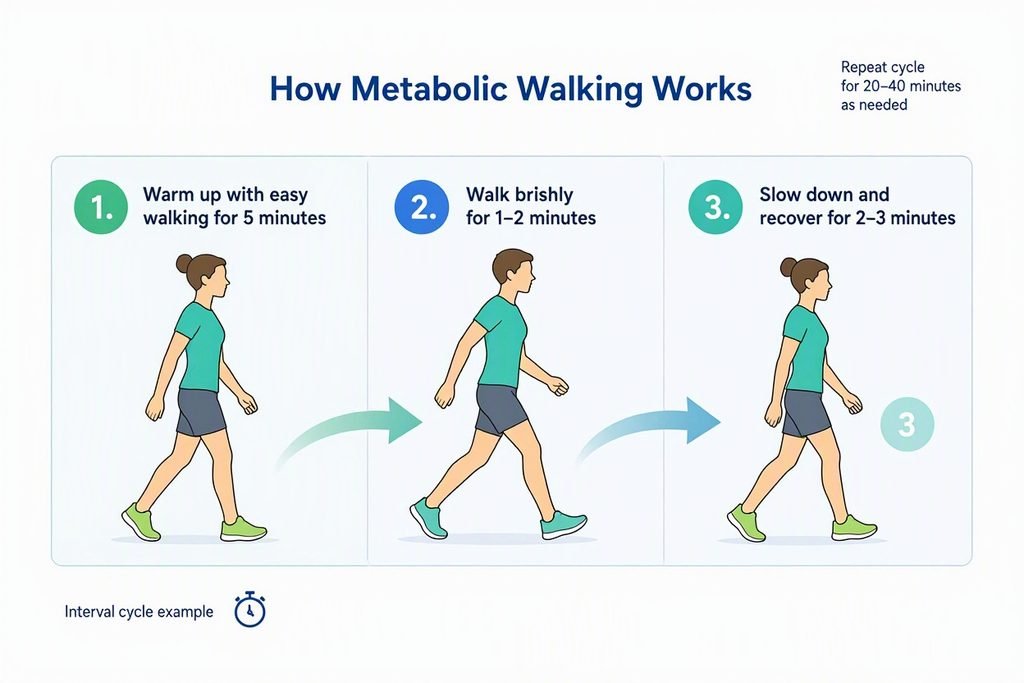
A typical metabolic walking workout includes four stages:
- Warm-up: Begin with easy walking to prepare your body.
- Brisk walking: Increase your pace for a short interval.
- Recovery walking: Slow down and allow your breathing to become more comfortable.
- Cool-down: Finish with a few minutes of relaxed walking.
You do not need to sprint or walk at your maximum speed. The faster intervals should feel more challenging than your normal pace while remaining manageable.
Is Metabolic Walking the Same as Interval Walking?
Metabolic walking and interval walking are closely related, but the terms are not necessarily interchangeable in every online program.
Interval walking is a broader exercise method that alternates between different walking intensities. Metabolic walking is a popular label often used for routines based on this same principle.
Here is a simple comparison:
| Feature | Metabolic Walking | Regular Walking | Interval Walking |
|---|---|---|---|
| Pace | Alternates between speeds | Usually steady | Alternates between intensities |
| Structure | Often follows a planned interval pattern | Continuous walking | Planned or flexible intervals |
| Intensity | Varies throughout the session | Usually consistent | Varies throughout the session |
| Beginner suitability | Can be adapted | Generally accessible | Can be adapted |
| Main purpose | Add variety and structure | Build daily activity | Vary exercise intensity |
The important point is that changing your walking speed is not a completely new form of exercise. It is a practical way to organize your activity and adjust the effort throughout a session.
Potential Benefits of Metabolic Walking
Metabolic walking may offer benefits associated with regular walking and interval-based physical activity. The results depend on your fitness level, workout intensity, frequency, and overall lifestyle.
1. Supports Cardiovascular Fitness
Brisk walking increases your heart rate and breathing compared with walking slowly. Alternating between different intensities can provide periods of greater effort during your workout.
Regular physical activity supports cardiovascular health and contributes to overall well-being.
The Centers for Disease Control and Prevention (CDC) explains how physical activity can benefit heart health, sleep, mood, and general health.
2. Helps Increase Daily Physical Activity
A structured walking routine can help you become more active throughout the week.
If you spend much of your day sitting, adding short walking sessions may help reduce sedentary time and make movement a more consistent part of your day.
You can also combine planned workouts with everyday activities such as walking during breaks, taking the stairs when appropriate, or choosing a walking route for short errands.
3. May Support Weight Management
Walking uses energy, and increasing your physical activity can contribute to the calorie deficit involved in weight loss.
Metabolic walking may help you stay active by making your workouts more structured and varied. However, it does not guarantee weight loss or automatically burn more fat than every other walking method.
Your results also depend on your food intake, total daily movement, sleep, and consistency.
If you want to understand how walking contributes to weight management, read our guide: Can You Lose Weight by Walking?.
4. Adds Variety to Your Exercise Routine
Walking at one steady pace can become repetitive for some people. Alternating between faster and slower intervals introduces a simple change in intensity.
This can make your sessions more engaging and give you clear goals to work toward as your fitness improves.
5. Can Be Adapted to Different Fitness Levels
You do not need to begin with long or intense intervals.
Beginners can use short brisk-walking periods followed by longer recovery periods. People with more walking experience may gradually increase the duration of their faster intervals.
The key is to adjust the workout to your current ability rather than copying a routine designed for someone else.
How to Do a Metabolic Walking Workout
You can try metabolic walking outdoors, on a treadmill, or on a suitable walking path. You generally do not need special equipment.
Follow these steps to organize your first session.
Step 1: Start With a Warm-Up
Walk slowly for approximately five minutes.
Use this time to settle into a comfortable rhythm and prepare for the faster intervals. Avoid starting your workout at a high intensity.
Step 2: Walk at a Brisk Pace
Increase your speed for a short period.
Your breathing should become quicker, and you should feel that you are working harder than during comfortable walking. However, you should still be able to speak.
Step 3: Slow Down for Recovery
Return to a comfortable walking speed.
Allow your breathing to settle before starting another brisk interval. Recovery periods are an important part of the workout.
Step 4: Repeat the Intervals
Alternate between brisk and comfortable walking for several rounds.
If you are a beginner, start with a small number of repetitions. You can gradually increase the number or duration of intervals as your fitness improves.
Step 5: Finish With a Cool-Down
Walk slowly for approximately five minutes at the end of your session.
This gives you time to return to a comfortable pace rather than stopping immediately after your final brisk interval.
4-Week Metabolic Walking Plan for Beginners
If you are new to interval walking, a gradual plan can help you build consistency without increasing your effort too quickly.
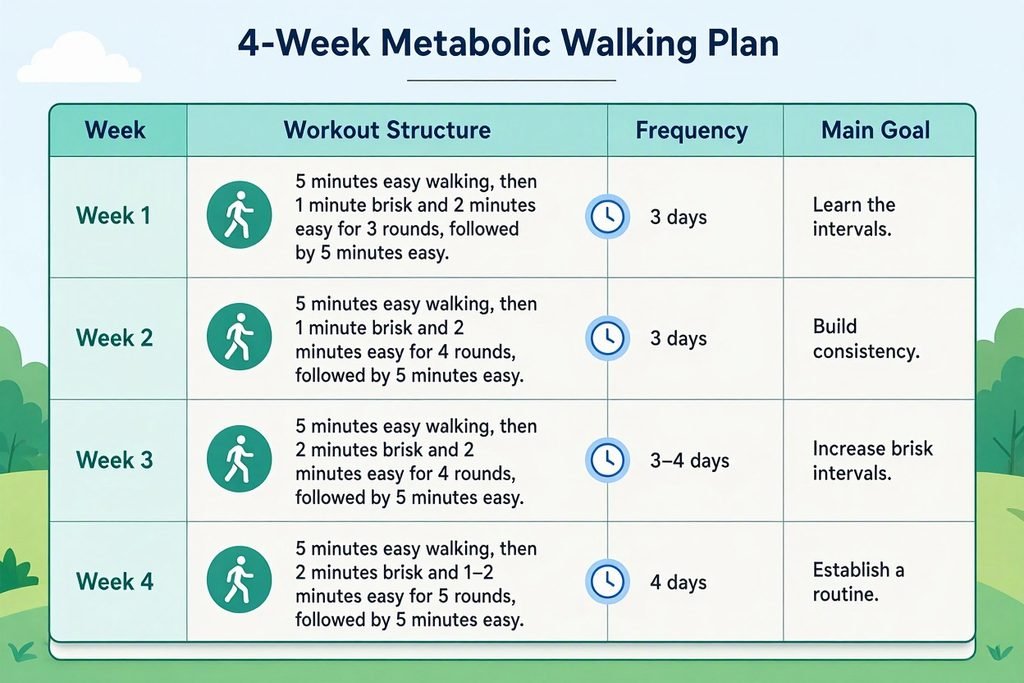
The following four-week schedule is an illustrative beginner plan. Adjust the duration and frequency according to your fitness level and how you feel during each session.
| Week | Workout Structure | Frequency | Main Goal |
|---|---|---|---|
| Week 1 | 5 minutes easy, then 1 minute brisk and 2 minutes easy for 3 rounds, followed by 5 minutes easy | 3 days | Learn the intervals |
| Week 2 | 5 minutes easy, then 1 minute brisk and 2 minutes easy for 4 rounds, followed by 5 minutes easy | 3 days | Build consistency |
| Week 3 | 5 minutes easy, then 2 minutes brisk and 2 minutes easy for 4 rounds, followed by 5 minutes easy | 3–4 days | Increase brisk intervals |
| Week 4 | 5 minutes easy, then 2 minutes brisk and 1–2 minutes easy for 5 rounds, followed by 5 minutes easy | 4 days | Establish a routine |
You do not have to progress every week. If a session feels too difficult, repeat the previous week’s structure or reduce the brisk intervals.
The CDC recommends that adults aim for at least 150 minutes of moderate-intensity physical activity each week, along with muscle-strengthening activities on two or more days. You can read the CDC adult physical activity guidelines.
Remember that your walking plan is only one part of your overall activity. You can gradually work toward the recommended weekly amount by combining walking sessions with other suitable activities.
How Long Should You Do Metabolic Walking?
The appropriate duration depends on your current fitness level and how much activity you already do.
Beginners may start with sessions lasting approximately 15–20 minutes, including warm-up and cool-down periods. As they become more comfortable, they may gradually extend their workouts.
Consider these general starting points:
- New to exercise: Begin with shorter sessions and longer recovery intervals.
- Some walking experience: Try slightly longer brisk intervals if they feel manageable.
- Regularly active: Adjust the workout duration and intensity according to your weekly exercise routine.
You do not need to complete a long session every day. Consistency and gradual progress are more important than forcing yourself to reach a specific duration.
Does Metabolic Walking Help You Lose Weight?
Metabolic walking may support weight loss because it increases physical activity and uses energy.
However, the name can create unrealistic expectations. There is no strong evidence that a workout becomes a special fat-burning method simply because it is called metabolic walking.
Weight loss generally requires maintaining an energy deficit over time. This means your body uses more energy than it receives from food and drinks.
Several factors influence your progress:
- Total daily physical activity.
- Food portions and overall eating patterns.
- Workout consistency.
- Sleep and recovery.
- Individual health and fitness factors.
For a more complete approach, combine walking with balanced meals and other activities that suit your needs.
You can also use our How Many Steps to Lose Weight Calculator to explore a daily walking target based on your personal information.
Common Metabolic Walking Mistakes to Avoid
Although metabolic walking is relatively simple, a few mistakes can make the workout harder to maintain.
Starting With Too Much Intensity
Trying to walk as fast as possible during your first session may leave you exhausted. Begin with a manageable pace and increase your effort gradually.
Skipping Recovery Intervals
Recovery periods allow you to slow down between brisk intervals. Removing them can make the session unnecessarily challenging, especially for beginners.
Ignoring the Warm-Up and Cool-Down
Starting quickly without preparing your body or stopping suddenly after intense intervals can make your workout less comfortable. Include easy walking at the beginning and end.
Expecting Immediate Weight-Loss Results
Changes in body weight do not happen at the same rate for everyone. Avoid judging your progress based on a few workouts or daily scale readings.
Following Every Online Workout
Social media videos may show routines that are not suitable for your current fitness level. Choose an approach that you can complete comfortably and safely.
Who Should Be Careful With Metabolic Walking?
Metabolic walking can be adjusted for many fitness levels, but increasing exercise intensity is not appropriate for everyone without consideration.
If you have a chronic health condition, significant joint pain, balance problems, or have been inactive for a long time, consider speaking with a healthcare professional before starting a new exercise routine.
Stop exercising if you experience chest pain, dizziness, unusual shortness of breath, or other concerning symptoms. Seek appropriate medical attention when necessary.
Choose comfortable footwear, walk on a suitable surface, and increase your activity gradually.
Frequently Asked Questions
What is metabolic walking and does it work?
Metabolic walking is a popular term for walking routines that alternate between faster and slower intervals. It can provide a structured way to increase physical activity, but it is not a proven shortcut for accelerating metabolism or losing weight.
Does metabolic walking boost metabolism?
Walking increases energy use while you are active. Regular physical activity supports overall metabolic health, but the effect varies between individuals. Metabolic walking should not be presented as a guaranteed way to permanently speed up metabolism.
How long should a metabolic walking workout last?
Beginners can start with approximately 15–20 minutes, including warm-up and cool-down periods. The duration can increase gradually as fitness improves.
Is metabolic walking suitable for beginners?
Yes, it can be adapted for beginners. Start with short brisk intervals, longer recovery periods, and a comfortable overall duration.
How many days a week should you do metabolic walking?
Beginners may start with three sessions per week and adjust their frequency as they become more comfortable. Your schedule should also allow enough time for recovery.
What is the difference between metabolic walking and regular walking?
Regular walking often involves maintaining a relatively steady pace, while metabolic walking typically alternates between faster and slower intervals. Both can contribute to physical activity and overall health.
Final Thoughts
Metabolic walking is a simple way to introduce interval-based exercise into your daily routine. By alternating between comfortable and brisk walking, you can add variety and gradually challenge your fitness level.
Although it is not a special fat-burning technique or a guaranteed way to speed up metabolism, it can be a practical approach to becoming more active.
Start with manageable intervals, allow enough time for recovery, and increase your effort gradually. The most useful walking routine is one that fits your lifestyle and that you can maintain consistently.
References
- Centers for Disease Control and Prevention (CDC). Health Benefits of Physical Activity for Adults.
- Centers for Disease Control and Prevention (CDC). Adult Physical Activity Guidelines.

Dr. Zakaria Alagha
Internal Medicine Resident Physician at Marshall University | MBBCh & MSc in Cardiovascular Diseases from Cairo University.
Passionate about medical research, teaching, volunteering, developing future medical professionals, and improving patient care.